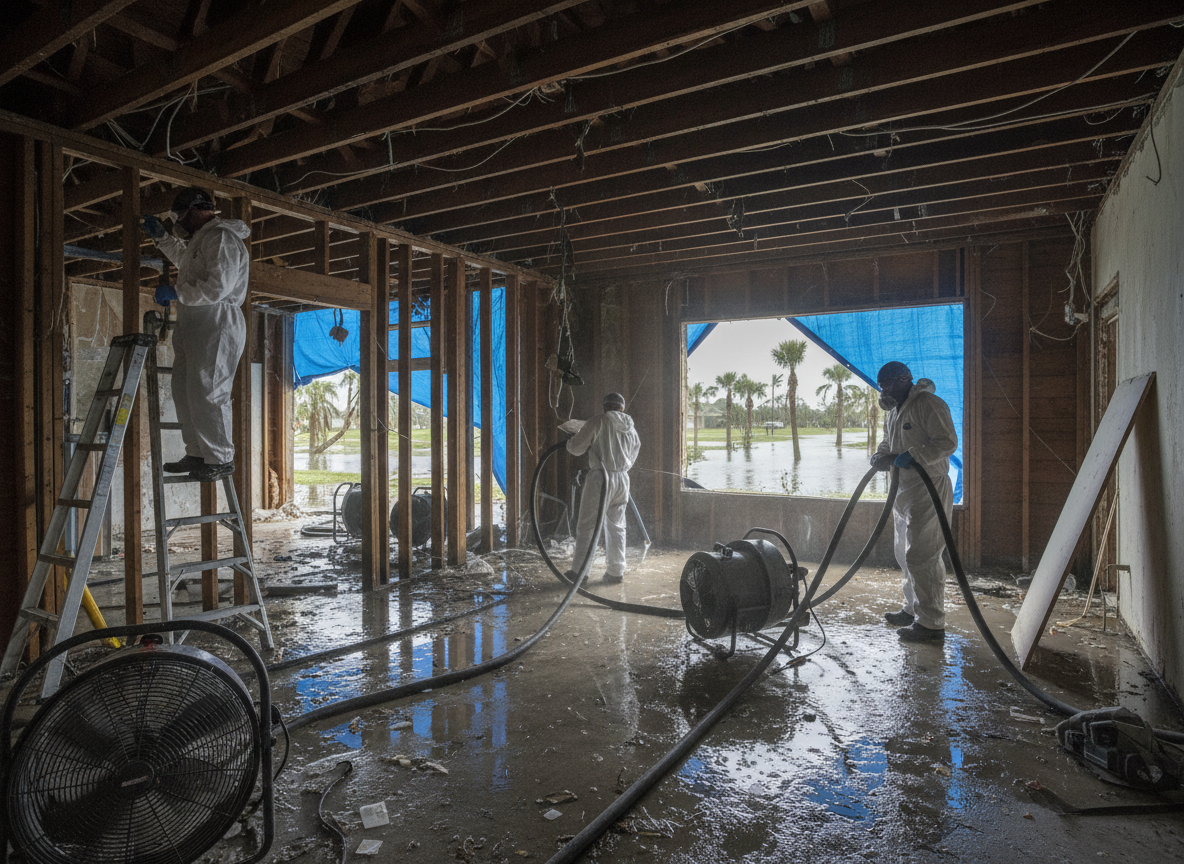
The storm passes, the shutters come down and the house looks untouched. A week later a brown ring appears on a bedroom ceiling, or the paint above a window starts to bubble. Wind-driven rain found a way in during the storm and has been sitting in the wall ever since. Storm damage repair starts with finding that entry point and drying what it reached, before the next storm uses the same opening again.
Why Naples homeowners call us after a storm
Storm work goes wrong when the visible damage is repaired and the water is left behind. A roofer closes the opening, the ceiling is painted, and the wall cavity underneath is still wet. The next strong rain finds the same path, or the cavity supports growth through the summer. Our sequence is built to read the water first and name the repair second.
The entry point is confirmed, not assumed. Water that appears at a ceiling may have entered at a roof valley, a lanai tie-in, a window track, a soffit or a wall penetration. We trace the path with a meter and thermal imaging and confirm where it is entering before anyone quotes a repair.
The wet boundary is measured. Wind-driven rain can travel along a wall cavity or a ceiling assembly well past the stain. Reading points are marked by room and location and photographed, so the extent is a number rather than a guess.
The restoration is separated from the envelope repair. We dry and restore the interior water damage. A roof, window, lanai or structural repair belongs to the trade that owns it, and we name that trade in writing rather than implying we will close every opening ourselves.
Naples buildings are read for what they are. A 1951 Naples Park cottage with a later lanai, a Pine Ridge house under mature oaks, a Pelican Bay tower with impact glass and a Pelican Marsh villa on a lake all take wind-driven rain differently. The opening that fails is usually the one added or altered last.
The record is written for the next person. Photographs, readings and a description of the entry point are handed to you and, where relevant, to the roofer or the association. The next trade should not have to start from a description of a stain.
Why storm damage in Naples gets worse after the storm
Hurricane season runs from 1 June to 30 November, and the storms do not need to be named to cause damage. A strong afternoon thunderstorm can drive rain sideways into a window track or a lanai for twenty minutes and leave water in a wall for weeks. Naples has a lot of housing designed for outdoor living, which means lanais, screened enclosures, sliding doors and roof tie-ins that are exposed to wind-driven rain.
The 2022 season showed what a named storm can do here. Hurricane Ian made landfall in Southwest Florida on 28 September 2022 and was particularly hard on Naples, with much of the damage from a storm surge reported at 10 to 15 feet. Naples Bay, the Gordon River and the canal network carried salt water into streets and ground floors. Wind-driven rain entered buildings that never flooded, through roof edges, window tracks, soffits and lanai tie-ins. Both kinds of damage can sit in the same house.
The weeks after a storm are the worst time to leave a wall wet. The ground is saturated, the humidity is high and more rain usually follows. A cavity that took water during the storm may not dry for the rest of the season. Material that could have been dried and kept is removed, a ceiling that could have been saved is replaced, and a small opening becomes a reconstruction. The earlier the assembly is read, the smaller the repair.
What you can check before you book storm damage repair
Water Damage Restoration Naples Florida works from 735 8th St S, Naples, FL 34102, in Collier County. The number is (239) 499-1170, and it is the same number shown in the footer of every page.
The services are exactly three. Water damage restoration covers water extraction and storm damage restoration as two named sub-services. Mold remediation covers containment, removal and correction of the moisture source. Storm damage repair is this page, and it includes water leak detection as a named sub-service. If a job needs a roof replacement, a window replacement or a structural rebuild, that work belongs to another trade and we will say so.
The areas are the city of Naples and eight Collier County communities within about ten miles: East Naples, Lely, Pine Ridge, Pelican Bay, Golden Gate, Vineyards, Pelican Marsh and Naples Park. Each one has a different exposure, from the Gulf-facing towers of Pelican Bay to the inland canal streets of Golden Gate, and the area pages describe the difference.
We do not publish a licence number, a certification, an insurance certificate, a founding year, project counts, ratings or reviews, because this business has not supplied those facts. We also do not claim to provide emergency response times or a fixed arrival window. What we can show is the method: a measured entry point, a written scope, photographs and readings before and after.
A Naples Park cottage where the lanai meets the house
Naples Park opened in 1951 as a community of small houses on small lots, and many of those houses have been extended, re-roofed and given a lanai. The place where the lanai roof meets the original wall is often the weakest detail on the property. It is a junction between two roof structures, two flashing systems and two wall finishes, and it is asked to shed water from a direction the original house never faced.
In a driving rain from the west, water can enter at that junction, run along the top plate and appear at the ceiling of the room behind it. The stain shows up inside, far from the roof. A roofer may re-seal the visible junction and the stain may stop for a season, because the opening only leaks when the wind drives rain at a particular angle. The cavity, meanwhile, has been wet more than once.
What makes this different from a generic roof leak is that the entry and the damage are in different assemblies. The repair is a flashing and envelope job, and the restoration is an interior drying job, and neither one alone solves the problem. We read the ceiling and the wall below the junction, compare the readings with an unaffected room, and scan the assembly with thermal imaging. If the path runs along the top plate, the ceiling may have to be opened to dry it. The flashing repair is then handed to a roofer with photographs of the path and the readings, so the repair is aimed at the actual opening rather than the stain.
The same logic applies to a screen enclosure added after the house was built, a pergola fixed to a wall, or a new impact window set into an older opening. Every addition creates a junction, and the junction is where wind-driven rain gets in.
Where storm water usually gets into a Naples house
Four details account for a large share of the storm water damage we are asked to scope in Naples. Each is an envelope detail, and each needs the opening identified before the interior is repaired.
A lanai tie-in where two roofs meet
The component is the junction between the lanai roof and the house wall: the flashing, the top plate and the finishes on both sides. It fails when the flashing is lapped the wrong way, sealed with a mastic that has aged, or fixed to a wall that has moved. What you notice is a ceiling stain near the junction, a musty room behind it or paint lifting at the top of the wall. The first move is to photograph the junction from outside and inside and stop using the room if the ceiling is sagging. The flashing repair belongs to a roofer; the interior drying is ours.
A window track with blocked weep holes
The component is the window frame, the track, the weep holes and the flashing above the opening. Water that should drain out of the track sits against the frame and enters the wall below the sill. What you notice is a damp sill, bubbling paint, a musty bedroom or a stain that appears only after rain from one direction. The first move is to clear the weep holes if they are accessible and photograph the interior before it is cleaned. The window repair belongs to a window contractor; the wall and insulation drying is ours.
A soffit or ridge vent that lets rain in sideways
The component is the soffit, the ridge vent, the screens and the roof underlayment behind them. In a wind-driven rain, water can be pushed through a vent that sheds ordinary rain without trouble. What you notice is a damp patch at the top of a wall, a stain on a ceiling near the eaves or insulation that has collapsed in the attic. The first move is to check the attic for daylight and damp insulation, without walking on a wet ceiling. The vent and roof repair belongs to a roofer; the ceiling and insulation assessment is ours.
A sliding glass door threshold
The component is the door frame, the track, the threshold and the drainage path under it. A threshold that has settled or a track that holds water can pass rain into the wall and floor at the corner. What you notice is a damp wall base beside the door, a swollen casing, a musty smell in the room or water under the flooring after a storm. The first move is to clear the track, dry the surface and keep the door closed until it is read. The door and threshold repair belongs to a door or general contractor.
The sub-service inside storm damage repair: water leak detection
Storm damage repair merges one named sub-service, water leak detection. It is the part of the job that decides whether the repair will hold, because a repair aimed at the wrong opening will fail the next time the wind comes from that direction. Detection is a process, not a guess based on where the stain is.
How water leak detection runs
- Interview the owner about when the water appears, which direction the wind was from and what changed on the building.
- Read the visible area and the assembly behind it with a moisture meter.
- Scan concealed walls, ceilings, roof edges and junctions with thermal imaging.
- Trace the moisture back to the entry point and confirm it against the exterior detail.
- Photograph the path, write down the readings and name the trade that owns the envelope repair.
What's included in water leak detection
- A moisture survey of the affected rooms and the assemblies around them
- Thermal imaging of concealed walls, ceilings and junctions
- Confirmation of the entry point, not just the stain
- Photographs of the interior path and the exterior detail
- A written description of the opening for the trade that will repair it
- A drying scope for the material the water reached
How a storm damage repair job runs in Naples
- Call and safety guidance. Tell us when the water appeared, which storm it followed and whether the ceiling is sagging or water is near an electrical fitting.
- Read the envelope from inside. We inspect the ceiling, wall bases, window and door tracks, lanai junctions and soffits, and scan concealed assemblies with thermal imaging.
- Confirm the entry point. The exterior detail is checked against the interior path so the repair is aimed at the opening that is actually leaking.
- Contain, extract and remove. Wet material that cannot be dried is removed inside a contained work area, and standing water is extracted.
- Dry against readings. Air movers, dehumidifiers and cavity drying run at the marked points until the assembly reaches a dry standard.
- Hand back and name the envelope trade. You receive the readings, photographs and a written hand-off for the roof, window, door or structural repair that belongs elsewhere.
What's included in storm damage repair
- Interior inspection after wind-driven rain or surge
- Moisture readings at roof edges, window tracks, lanai junctions and soffits
- Thermal imaging of concealed walls and ceilings
- Extraction of standing water and removal of storm-wet material
- Cavity drying where water entered a wall or ceiling
- Containment and air filtration where needed
- A written record of the entry point and the readings before and after
- A named hand-off for roof, window, door or structural repair
What to do next
Call (239) 499-1170 and describe when the water appeared, which storm it followed and where the stain is. If a ceiling is bulging, keep the room clear and do not press on it. We work from 735 8th St S in Naples and cover the city plus eight Collier County communities within about ten miles.