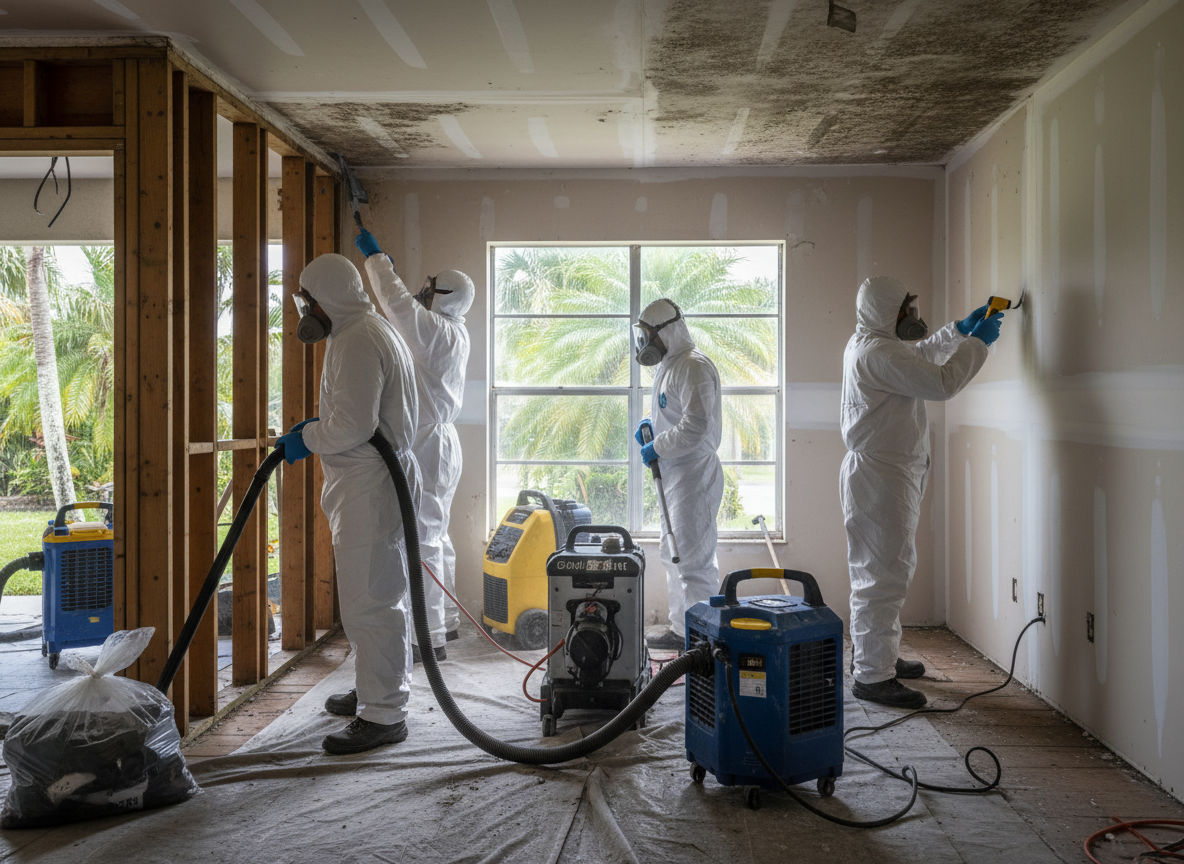
Mold remediation in Naples often starts with a smell rather than a stain. A guest room that smells musty only when the air conditioning runs, a closet behind a bathroom, a cabinet toe kick that has darkened: the growth is usually on the back of a material that stayed damp after a leak everyone thought was fixed. The work is to find the moisture that is still there, contain the area, remove what cannot be saved and correct the source.
Why Naples homeowners call us for mold work
Mold is a symptom. Treating the visible patch without finding the water is the reason it comes back, and it is the most common problem we are asked to correct. Our work is built around four decisions: where the moisture is coming from, how far the growth extends, what has to be removed, and how the area will be verified before it is closed up.
The moisture source is identified first. A bathroom exhaust that discharges into the attic, a supply line that dripped behind a vanity, a window track that holds rain or an air handler that has been overflowing all leave different evidence. We find the source before containment goes up, because remediation without correction is a temporary result.
The work area is contained before anything is disturbed. Disturbing growth without containment can move spores through a house, especially when the air conditioning is running. We seal openings, protect the route and filter the air so the rest of the home is not part of the work zone.
Material is removed, not painted over. Porous material that has supported growth, such as drywall paper, insulation, carpet pad and some cabinet board, cannot be cleaned back to a sound state. We remove it, bag it and dispose of it, and we tell you what is being removed before it comes out.
The scope is written and the hand-off is named. A bathroom fan that vents into the attic needs a roofer or an HVAC contractor. A failed supply line needs a plumber. A wall that has to be rebuilt needs a general contractor. We name the trade in writing rather than implying we cover it.
No health claims. We are not physicians and we do not diagnose illness. If you have a health concern tied to a damp building, that conversation belongs with your doctor. Our job is the building: find the moisture, remove the affected material, dry the assembly and leave a record.
Why mold work in Naples cannot wait for a dry week
Naples does not offer many dry weeks. Relative humidity stays high for most of the year, air conditioning keeps interior surfaces cool enough to condense moisture, and the rainy season runs through the same months as hurricane season. A wall cavity that is damp in June is unlikely to dry on its own in July. Growth can begin in about a day or two on a damp surface, and a closed house with the system off can support it faster.
The seasonal pattern makes it worse. A large share of Naples housing is not occupied year-round. A condo that is shut up for the summer with the air conditioning set high, the water off at the fixture but not at the riser, and the blinds closed is a still, warm, humid box. A slow supply-line weep or a condensate overflow in that unit has weeks to work before anyone opens the door. By the time the owner arrives, the smell is in the bedding and the wall behind the headboard.
Waiting also changes the scope. Growth that is confined to one side of a wall may mean removing a section of drywall and insulation. Left through a wet season, the same moisture can reach the wall cavity, the cabinet run and the floor assembly, and the containment grows with it. The cost is not only the remediation; it is the material, the contents handling and the time the unit cannot be used.
What you can check before you book mold remediation
Water Damage Restoration Naples Florida works from 735 8th St S, Naples, FL 34102, in Collier County. The phone number is (239) 499-1170, and it reaches the same business shown in the footer of every page.
The services are three: water damage restoration (which includes water extraction and storm damage restoration), mold remediation, and storm damage repair (which includes water leak detection). Mold remediation is this page. It covers containment, removal of affected material and correction of the moisture source where growth is visible or a cavity has stayed damp. It does not include clearance testing, medical advice or reconstruction.
The areas are the city of Naples and eight Collier County communities within about ten miles: East Naples, Lely, Pine Ridge, Pelican Bay, Golden Gate, Vineyards, Pelican Marsh and Naples Park. The housing differs enough that the area pages are written separately, because a seasonal tower unit and a 1950s cottage fail in different places.
We do not publish a licence number, certification, insurance certificate, founding year, staff biographies, project counts, ratings or reviews, because this business has not supplied those facts. We also do not claim that a remediation is "passed" or "cleared" by an authority we do not have. If your association or insurer requires independent clearance testing, we will tell you that it is a separate specialist service and help you plan around it.
A Pelican Bay tower unit that was closed for the summer
The situation is common in Pelican Bay and along the beach: a high-rise unit used from December to April and closed for the rest of the year. The owner turns the air conditioning up, closes the shutters, shuts the water off at the fixtures and leaves. The building is sound, the unit is secure, and nothing looks wrong when the door is opened in October. What has changed is the air inside. A closed unit in a Naples summer holds humidity, and the cold surfaces, the exterior walls and the air-handler closet stay damp.
The moisture usually starts small. A shutoff valve that weeps at the packing, a condensate line that clogs with algae, a supply line to the ice maker that has been under pressure all summer. In a house that is occupied, someone notices a damp cabinet or a smell. In a closed unit, the first evidence is often a musty guest room, a dark line along the baseboard behind a bed, or growth on the wall behind the air-handler closet. By then the cavity may have been damp for weeks.
A tower adds complications that a house does not have. The work area has to be contained inside a building with shared corridors and a shared air system. Protection for the corridor, elevator pads, work-hour limits and building-manager notification are part of the job, not extras. If the moisture is coming from a riser or a common-element line, the association is involved, and the boundary between unit and common element has to be documented before anyone opens a wall.
Our sequence in a unit like that is to read the assembly first, confirm whether the source is inside the unit or in the building, contain the affected room, remove the material that cannot be saved, filter the air and dry the cavity. The written record names the readings and the boundary. If the source belongs to the association, the report goes to the building manager with photographs rather than a verbal description. That is what makes a repair possible without a second argument about who owns it.
Where mold in Naples usually starts
Four locations account for most of the mold work we are asked to scope in Naples. Each is a moisture problem with a building cause, not a cleaning problem.
A bathroom exhaust that discharges into the attic
The component is the exhaust fan, its duct and the termination. In many older Naples houses the fan runs, the ceiling stains, and the duct either stops in the attic or is disconnected at the roof cap. What you notice is peeling paint at the bathroom ceiling, a musty smell in the hallway or condensation on the mirror that never clears. The first move is to check where the duct actually goes, from the attic if it is accessible, and to stop using the fan until it is corrected. The termination is a roofing or HVAC repair; the remediation of the damp ceiling and framing is ours.
A supply line weeping behind a vanity
The component is the braided line, the shutoff valve and the drain trap inside a vanity cabinet. These fail slowly, and the cabinet floor holds the water against the wall base. What you notice is a dark stain on the cabinet floor, a soft toe kick, a smell when the doors are opened or paint lifting on the wall behind the vanity. The first move is to shut the valve, empty the cabinet and leave the doors open so the area can be read. The plumbing repair belongs to a plumber; the cabinet assessment, containment and drying are ours.
An air-handler closet with a clogged condensate pan
The component is the air handler, the coil, the primary drain, the secondary pan and the float switch. In Naples the system runs almost continuously, so the coil produces condensate every day. What you notice is a musty smell at the supply registers, a rust ring on the platform, water on the closet floor or a stain on the ceiling below. The first move is to switch the system off and check the pan and float switch before it runs again. The drain correction is an HVAC repair; the damp closet, insulation and ceiling are ours to contain and dry.
A window track that has held rain since the last storm
The component is the window frame, the track, the weep holes and the flashing above the opening. Wind-driven rain enters where the track drains poorly or the flashing has failed, and the water sits in the wall below the sill. What you notice is a soft sill, bubbling paint, a musty bedroom or a stain that appears only after a storm from a particular direction. The first move is to photograph the interior and exterior, clear the weep holes if they are blocked and stop using the window until the opening is repaired. The envelope repair belongs to a window or roofing contractor.
How mold remediation runs in Naples, step by step
The sequence is designed to keep the rest of the house out of the work zone and to make the end point measurable.
- Assess and find the moisture. We read the affected rooms and the assemblies around them with meters and thermal imaging, and confirm whether the source is still active.
- Write the scope. The scope names the material to be removed, the containment, the air filtration and any repair that belongs to another trade.
- Contain the work area. Openings are sealed, the route is protected and the containment is put under negative pressure where the work warrants it.
- Remove affected material. Porous material that has supported growth is removed, bagged and disposed of; surfaces that can be cleaned are cleaned.
- Dry and verify. The cavity is dried against readings, and the final numbers are compared with the day-one record before the containment comes down.
- Hand back with a record. You receive the photographs, the readings and a written note of what was removed, what was cleaned and which repair belongs to another trade.
What's included in mold remediation
- A moisture assessment of the affected rooms and surrounding assemblies
- Containment of the work area, including openings and the route
- HEPA filtration and negative pressure where the scope requires it
- Removal and bagged disposal of material that cannot be saved
- Cleaning of surfaces that can be saved
- Drying of the cavity against recorded readings
- A written record of what was removed, cleaned and read
- A named hand-off for plumbing, roofing, HVAC or rebuild work
What is not included
- Independent clearance testing or laboratory analysis
- Medical advice or diagnosis
- Reconstruction of removed drywall, cabinetry or trim
- Work on common elements that the association controls, without the association's approval
What to do next
Call (239) 499-1170 and describe where the smell is strongest, what the room looked like after the last leak and whether the space has been closed up. If a wall or ceiling is soft, keep the area clear and do not disturb it. We work from 735 8th St S in Naples and cover the city plus eight Collier County communities within about ten miles.