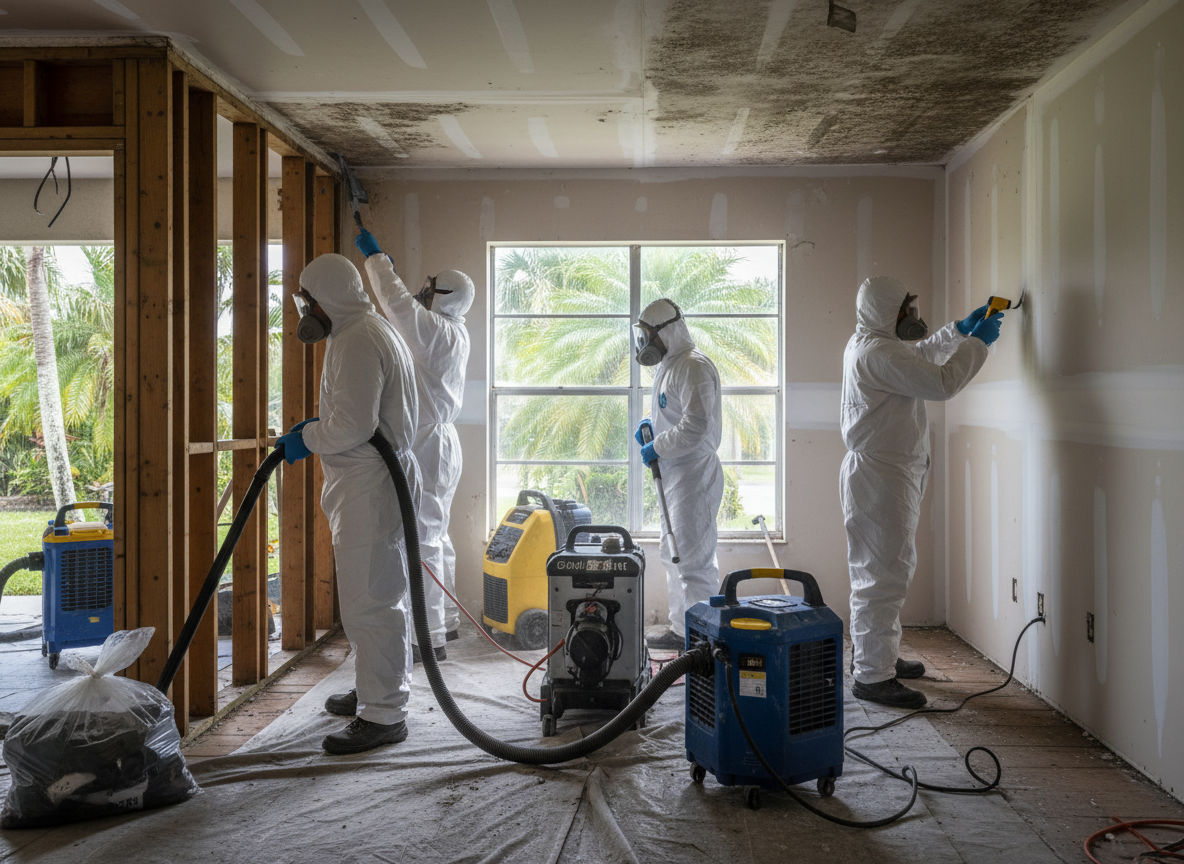
East Naples is the unincorporated community immediately east and south of the city, and it has been the Collier County seat since 1962. Water damage here often starts in housing that predates modern drainage: slab floors, older plumbing and streets that collect storm water from a wide area. This page explains what we look for in East Naples and how a water or mold job here is scoped.
What makes water damage in East Naples different?
East Naples sits low, developed early and carries the county's civic core. Its average elevation is about seven feet, much of its housing was built between the 1950s and 1980s, and the neighbourhoods nearest the bay and the Gordon River take water from both rain and tide. The age of the plumbing matters as much as the weather.
The county seat on low ground
The Collier County Courthouse has been in East Naples since 1962, when the seat moved from Everglades after a county-wide vote. That civic history explains the road pattern and the age of the commercial corridor along US-41, but the water story is simpler: much of the community sits at roughly seven feet above sea level on flat ground. Storm water moves slowly, swales and ditches fill, and a heavy afternoon storm can leave water against a wall base for longer than the rain lasts. Older slab homes have no cavity below the floor to drain into, so moisture wicks upward into tile, terrazzo and the bottom plate of the wall.
Housing built before the drainage caught up
East Naples grew quickly in the decades after the Second World War, and a large share of its houses date from the 1950s through the 1980s. That era brought slab-on-grade construction, cast-iron and galvanised drain lines, and supply lines that are now well past their expected service life. Additions were common: a Florida room, a garage conversion, a second bathroom. Each addition created a new junction where water can enter and a new assembly that may not match the original. When a drain line fails under a slab or a supply line lets go inside a wall, the water often surfaces in a room that was added later.
Naples Bay and the Gordon River at the edge
East Naples runs to Naples Bay and the Gordon River, both tidal water bodies connected to the Gulf through Gordon Pass. During a strong storm or a high tide, the drainage system can be full at the same time the rain arrives, and water has nowhere to go but into streets, yards and the low openings of a house. Hurricane Ian made landfall in Southwest Florida on 28 September 2022 and was particularly hard on Naples, with much of the damage from a storm surge reported at 10 to 15 feet. Surge is salt water and is treated as contaminated, which changes what can be dried and what has to be removed. Even a minor tidal backup leaves salt and sediment behind a wall base.
Who serves the address
East Naples is unincorporated Collier County, so building permits and drainage questions go to the county rather than a city. The community has no municipal building department of its own, and the county also maintains much of the road and drainage network. US-41 is a state road, so work that affects its right of way involves the state as well. For a water job, the practical question is who owns the pipe or the swale: a private line inside the lot, a county system in the street, or a shared easement behind the houses. The answer decides who corrects the cause.
What an East Naples addition can hide
A Florida room, a converted garage or a second bathroom is often where an East Naples water problem surfaces, because the addition is the newest assembly attached to the oldest house. The original slab may have been cut for a drain, the new floor may have been laid over a surface that was never sealed, and the junction between the old wall and the new opening is a place where rain and irrigation water can enter. What you notice is a soft baseboard at the junction, a smell that is strongest in the added room or a tile that sounds hollow when tapped.
The honest way to read it is to compare the addition with the original house. We mark readings on both sides of the junction, check the exterior at the door or the patio that serves the addition, and look at how the new roof or screen enclosure meets the old wall. If the addition sits on its own slab, the two slabs can move differently, and the gap between them becomes a path for water. If the addition reused the original slab, the drain cut is a weak point that a later floor covering can hide.
Repairing the finish without reading the junction is how an addition gets tiled twice and still smells. The sequence is to find the entry, dry the assembly and hand the exterior repair to the trade that owns it. In a county-seat neighbourhood full of later additions, that sequence matters more than the age of the house on the deed.
What does an East Naples home need?
An East Naples house usually needs the water found before the floor is disturbed, because the slab and the older finishes hide it well. The job starts with a read, not a demolition.
When water has entered from a storm, a door track or a tidal backup, water damage restoration covers the two phases that matter here: extraction and storm damage restoration. Extraction removes the standing water and the water held in carpet, pad and cabinet bases. Storm work reads the wall and floor assemblies that took water at the opening. In an older slab house, the wet boundary often runs further than the visible stain because the slab moves water sideways under a sealed floor.
When a pipe has failed and water is standing in a bathroom, kitchen or garage, storm damage repair includes the leak detection that finds the entry. A slab leak, a failed shutoff or a drain line under the floor is a plumbing repair, and the detection work tells the plumber where to open. The drying that follows is ours.
When a wall, cabinet or ceiling has stayed damp long enough to smell, mold remediation is the next service. Containment matters in older homes because the wall cavities are often connected to the attic and the air handler closet. Removing the affected material without sealing the work area can move spores through the return air.
In a county-seat neighbourhood where many houses have been added to over the decades, the most useful first step is often the least dramatic: read the junction between the original house and the addition before any finish is removed. We also cover Lely, Golden Gate, Vineyards, Pine Ridge, Pelican Marsh, Pelican Bay and Naples Park, all within about ten miles of East Naples.
Why use us in East Naples?
Because an older slab house needs a read, not a bigger demolition. We work from 735 8th St S in the city of Naples, about two miles from East Naples, and we start with the wall base, the cabinet toe kick and the slab rather than assuming the visible stain is the whole story. We separate the water work from the plumbing repair, the county drainage question and any rebuild, and we put the scope and the readings in writing. We do not publish credentials, ratings or reviews this business has not supplied.
Why East Naples water damage gets worse quickly
East Naples has a large year-round population and a large older housing stock, and both matter after a leak. The 2019–2023 American Community Survey estimated 19,024 residents, with a median age of 56 and 41.6% of the population aged 65 or older. Older residents are more likely to be home when a water heater fails, which helps, but they are also more likely to leave a small damp patch until it becomes a visible problem. A house that is closed up for part of the season has the opposite problem: nobody sees the leak at all.
The climate does the rest. Relative humidity stays high for most of the year, air conditioning keeps interior surfaces cool, and the rainy season overlaps with hurricane season from June through November. A wall cavity that is damp in July is unlikely to dry in August. Growth can begin in about a day or two on a damp surface. By the time a smell is noticeable in a bedroom, the material behind the wall has usually been wet for weeks, and the scope has grown from a baseboard to a wall section.
How an East Naples job runs, step by step
- Call and safety guidance. Tell us where the water appeared, whether it came from rain, tide or a fixture, and whether the house is on a slab.
- Read the assembly. We mark reading points at the wall base, cabinet floors, door tracks and slab, and scan concealed areas with thermal imaging.
- Contain and extract. The work area is contained where growth is likely, standing water is extracted and saturated material is assessed.
- Dry against readings. Air movers and dehumidifiers run at the marked points until the slab and wall base reach a dry standard.
- Verify and hand back. Final readings are compared with day one, and the record names any plumbing, drainage or rebuild work that belongs elsewhere.
What's included in an East Naples job
- A moisture survey of wall bases, cabinet floors, door tracks and the slab
- Thermal imaging where the entry or the path is concealed
- Extraction of standing water and removal of saturated material
- Containment and air filtration where growth is disturbed
- Drying equipment positioned against marked readings
- A written record of readings before and after
- A named hand-off for plumbing, county drainage or rebuild work
Nearby areas we also cover from East Naples
Lely is about 2 miles away, Golden Gate about 5, Vineyards about 7, Pine Ridge about 8, Pelican Marsh and Pelican Bay about 9. All are in Collier County and within the ten-mile service radius from our 8th Street South address. Each has its own page because the housing and the water pattern differ.
What should you do next?
Call (239) 499-1170 and tell us the age of the house, where the water showed up and whether the source is rain, tide or a fixture. If a ceiling is bulging, move what is underneath it and keep the room clear. We cover East Naples from our base at 735 8th St S in Naples.
Around East Naples
We regularly work near:
- 📍Collier County Courthouse
- 📍Naples Bay
- 📍Gordon River
Water Damage Restoration in East Naples — Local Notes
- •Unincorporated Collier County; the county seat since 1962.
- •ZIP 34112, average elevation about 7 feet.
- •Housing from the 1950s–1980s on slab, with many later additions.
- •Naples Bay and the Gordon River form the western edge.