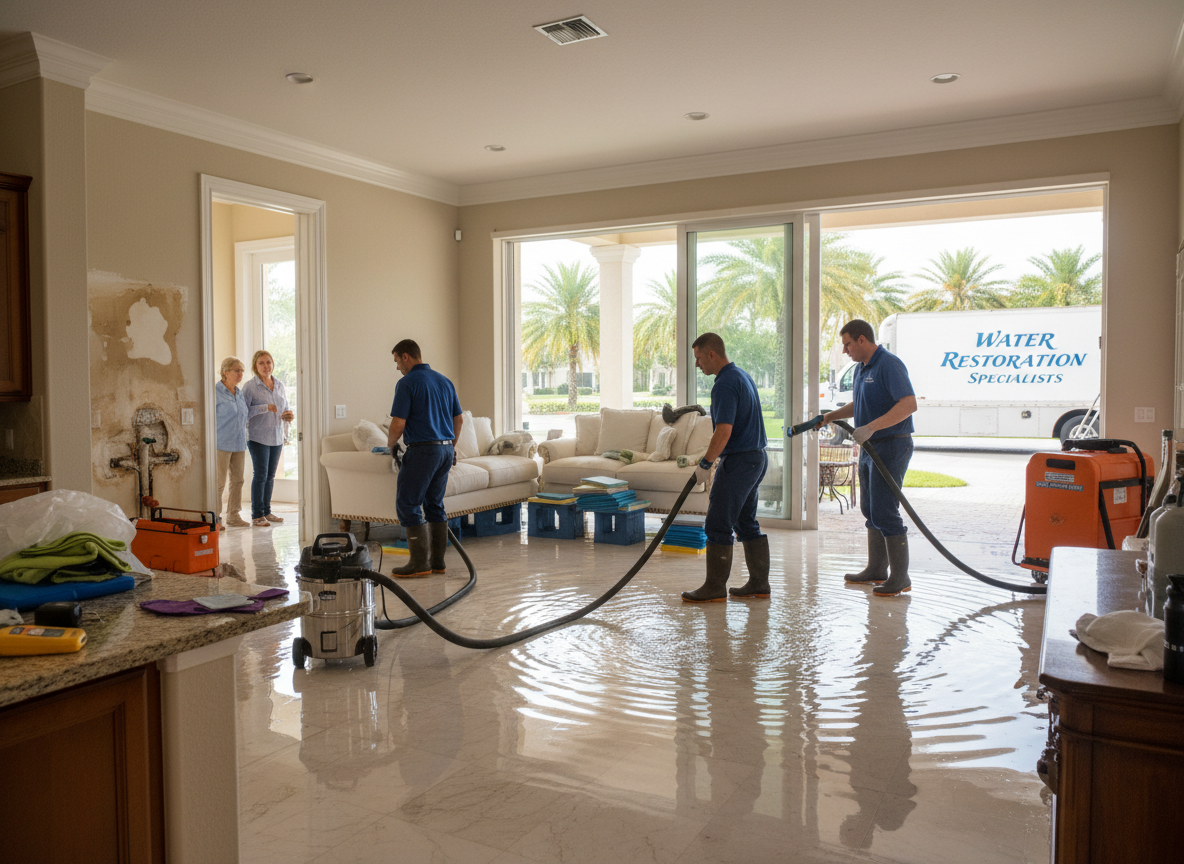
Vineyards is a gated golf-course community in northwest Collier County, bordered by Interstate 75 on the west with access at Exit 107 and about ten miles northeast of downtown Naples. Lakes, irrigated fairways and housing from the 1980s and 1990s shape the water problems here: a supply line behind a wet bar, an air handler above a ceiling or lake water that rises after a heavy storm. This page explains what we look for in Vineyards.
What makes water damage in Vineyards different?
Vineyards is a gated, lake-rich golf community with a housing stock that is now mature. Water arrives from three directions: the lakes and irrigation system at ground level, the original plumbing inside the walls, and the roof and air-handler details above. A leak in a coach home can cross a shared wall before it shows in the unit where it started.
A gated golf community beside I-75
Vineyards is bordered to the west by Interstate 75, with access from Exit 107, and it sits about ten miles northeast of downtown Naples. The location is convenient and it shapes the work: access is through a gate, work hours and vendor approval are controlled by the association, and equipment and removed material have to follow a route that the community allows. I-75 also means traffic noise and road grime on the western edge, which is a maintenance issue rather than a water one, but it explains why exterior surfaces on that side age differently. We ask about gate access and approval on the first call so the assessment is not spent waiting.
Lakes and irrigated fairways
About 14% of the CDP is water, and the lakes are working parts of the community rather than scenery. They hold storm water, they supply irrigation, and they sit close to lanais, pool cages and foundations. In a wet season the lake level rises, the ground around it saturates, and water moves toward the lowest slab. An irrigation line that fails under a lawn can run for days before anyone notices, and the water often surfaces against a wall or under a driveway rather than at the break. A lake-front house can have a damp wall base on the lake side for weeks after the rain stops.
Housing from the 1980s and 1990s, now mature
Most of the housing in Vineyards was built as a planned golf community in the 1980s and 1990s. At that age, the original supply lines, shutoff valves, water heaters, air-handler pans and roof details are at or past their expected service life. A braided supply line can fail at the crimp, a shutoff can seize and then weep when it is finally turned, and a condensate line can clog repeatedly. The original roof may also be at the end of its life, and a roof leak in a golf-course house often shows at a lanai junction rather than in the middle of a ceiling.
Who serves the address
Vineyards is unincorporated Collier County, so building permits and drainage questions go to the county rather than a city. The community association controls gate access, work hours, vendor approval, roof and common-element repairs, and often the approval to open a wall in an attached unit. I-75 is a state and federal highway, so work affecting its right of way is outside the community's control. For a water job, the practical question is whether the failed component is inside the unit, in a shared wall or in the lake and irrigation system that the association maintains.
A Vineyards house where the irrigation runs from the lake
The pattern is specific to a lake-rich golf community: a house on the water, an irrigation system fed from the lake, and a lawn that stays green through the dry season. The pump and the lines are part of the property, and a break in a lateral can run for days before it shows. The water surfaces against the wall, under the driveway or at the edge of the lanai, and the first sign inside is often a damp wall base or a musty room rather than a puddle.
Lake-fed irrigation adds a complication that municipal water does not. The system can run on a timer while the house is empty, and a failed valve or a cracked lateral keeps delivering water to the same spot. The water is not clean drinking water; it carries lake sediment and organic material, so material that stays wet is more likely to support growth. The repair is an irrigation job, and the drying and any remediation are ours.
Our sequence is to read the wall base and the lanai slab, check the irrigation zones and the pump, and confirm whether the water is coming from the lake system, the roof or a plumbing line. If the source is irrigation, we tell the owner which zone and which head or lateral, so the irrigation contractor is not digging up the whole lawn. If the wall is wet, we contain the area, remove what cannot be saved and dry the assembly against readings. The written record separates the irrigation repair from the interior work.
What does a Vineyards home need?
A Vineyards home usually needs the lake and irrigation system ruled in or out before the interior is opened, because ground-level water is as likely as a roof leak. The job starts with a read of the wall base, the lanai and the air-handler closet.
When a storm or a lake has pushed water into a lanai or a ground-floor room, water damage restoration covers extraction and storm damage restoration. In a lake-front house the wet boundary can run along the whole wall base, so we mark readings across the room rather than treating one patch. Extraction removes the standing water; the storm work reads the opening and the wall assembly.
When an irrigation line, a supply line or a water heater has failed, storm damage repair includes the leak detection that finds the entry. An irrigation or plumbing repair belongs to the trade that owns it, and the detection work tells that trade where to dig or open. The drying that follows is ours.
When a wall, cabinet or ceiling has stayed damp long enough to smell, mold remediation is the next service. In a coach home with a shared wall, containment matters because air can move between units. We seal the work area and filter the air before any material is disturbed.
We also cover Golden Gate, Pelican Marsh, Pine Ridge, Pelican Bay, Naples Park, East Naples and Lely, all within about nine miles of Vineyards.
Why use us in Vineyards?
Because a lake-front golf home needs the ground and the building read together. We work from 735 8th St S in Naples, about seven miles from Vineyards, and we start with the wall base, the lanai and the irrigation zones rather than assuming the stain is a roof leak. We separate the water work from the irrigation, plumbing and association repairs, and we put the scope and the readings in writing. We do not publish credentials, ratings or reviews this business has not supplied.
Why Vineyards water damage gets worse quickly
Vineyards has a high water table, a lake system and a seasonal population, and the combination is unforgiving. The ground around a lake stays saturated after a storm, so a wall base that took water has a continuing source outside it. A unit that is closed for the summer stays warm and humid, so the material does not dry. Growth can begin in about a day or two on a damp surface, and a house that is empty for months gives it time.
Hurricane season runs from 1 June to 30 November. Hurricane Ian made landfall in Southwest Florida on 28 September 2022 and was particularly hard on Naples, with much of the damage from a storm surge reported at 10 to 15 feet. Vineyards is inland and about 16 feet above sea level, so surge is not the usual story, but the rain and the saturated ground are. A lake that is already high has no room for another afternoon storm, and water takes the shortest path to the lowest slab.
How a Vineyards job runs, step by step
- Call and gate access. Tell us the address, the gate procedure and whether the association needs to approve the visit.
- Read the assembly. We mark reading points at the wall base, lanai, cabinet floors and air-handler closet, and scan concealed areas with thermal imaging.
- Confirm the source. We check the irrigation zones, lake edge, roof line and plumbing against the interior path.
- Contain and extract. The work area is contained, standing water is extracted and saturated material is assessed.
- Dry against readings. Air movers and dehumidifiers run at the marked points until the assembly reaches a dry standard.
- Verify and hand back. Final readings are compared with day one, and the record names any irrigation, plumbing or association repair.
What's included in a Vineyards job
- A moisture survey of wall bases, lanais, cabinet floors and the air-handler closet
- Thermal imaging where the entry or the path is concealed
- Extraction of standing water and removal of saturated material
- Containment and air filtration where growth is disturbed
- Drying equipment positioned against marked readings
- A written record of readings before and after
- A named hand-off for irrigation, plumbing or association work
Nearby areas we also cover from Vineyards
Golden Gate is about 3 miles away, Pelican Marsh about 4, Pine Ridge about 4, Pelican Bay about 5, Naples Park about 6, East Naples about 7 and Lely about 9. All are in Collier County and within the ten-mile service radius from our 8th Street South address.
What should you do next?
Call (239) 499-1170 and tell us whether the house is on a lake, where the water appeared and when the irrigation last ran. If a wall is damp, keep the area clear and do not paint over it. We cover Vineyards from our base at 735 8th St S in Naples.
Around Vineyards
We regularly work near:
- 📍Vineyards Country Club
- 📍Vineyards Boulevard
- 📍I-75 Exit 107
Water Damage Restoration in Vineyards — Local Notes
- •Census-designated place in Collier County, ZIP 34119.
- •Bordered west by I-75, with access from Exit 107.
- •About 14% of the CDP is water, mostly community lakes.
- •Most housing dates from the 1980s and 1990s.