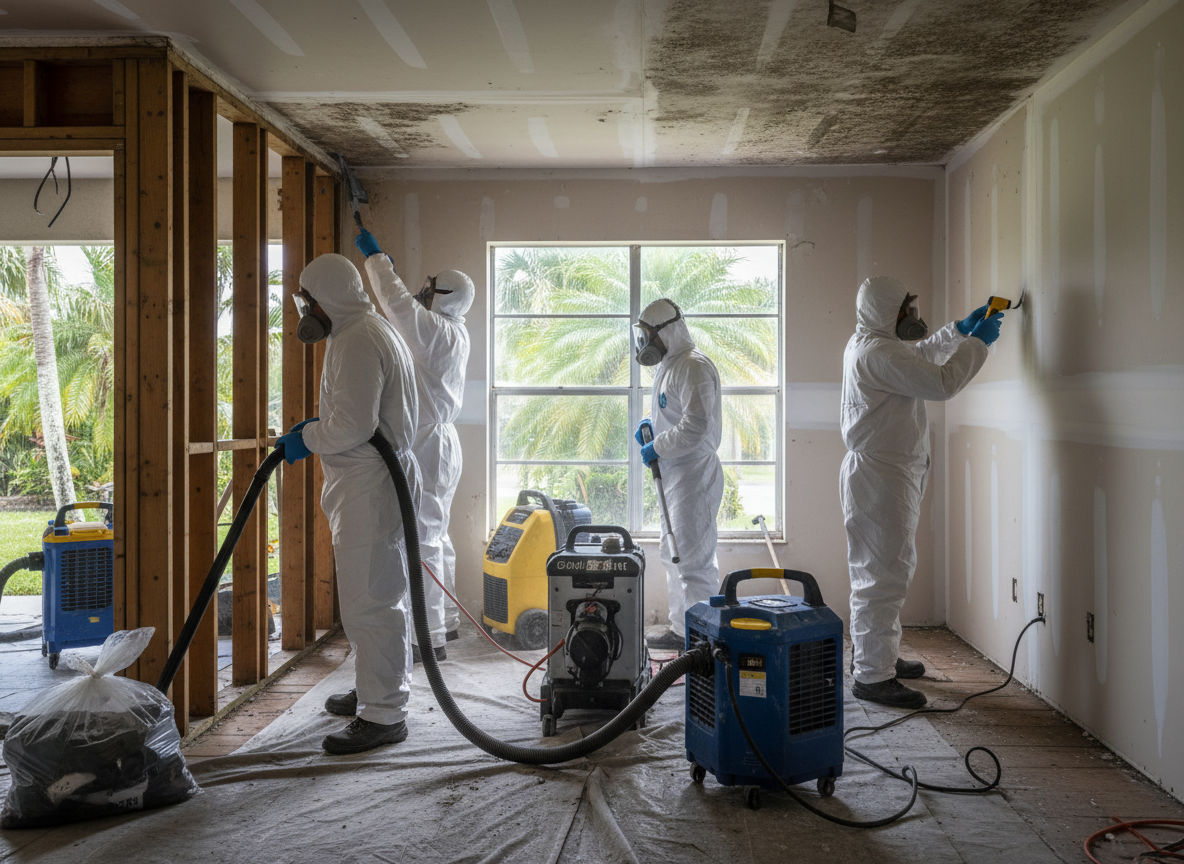
Pelican Bay is a master-planned coastal community between the Gulf and US-41, with beachfront towers, villas, courtyard homes and a large seasonal population. Water damage here often involves a unit that was closed for months, a shared riser or a storm that pushed salt water through a ground-floor opening. This page explains what we look for in Pelican Bay and how a job here is scoped.
What makes water damage in Pelican Bay different?
Pelican Bay is a coastal community with shared building systems. The Gulf is the western boundary, US-41 the eastern one, and much of the housing is attached, stacked or managed by an association. Water can start in one unit and show up in another, which makes documentation as important as drying.
Between the Gulf and US-41
Pelican Bay is bordered by the Gulf of Mexico to the west, US-41 to the east, Vanderbilt Beach Road to the north and the city of Naples to the south. The community includes mangrove shoreline, Clam Pass and a beach club reached by tram, and the salt air is part of every exterior surface. During a named storm the coast is exposed to surge as well as rain. Hurricane Ian made landfall in Southwest Florida on 28 September 2022 and was particularly hard on Naples, with much of the damage from a storm surge reported at 10 to 15 feet. In a ground-floor villa or a tower lobby, that means salt water, sediment and a cleaning scope that is different from a rain leak.
Towers, villas and shared systems
A large share of Pelican Bay housing is attached or stacked: high-rise towers, low-rise buildings, villas and courtyard homes. Water travels through those buildings in ways it cannot in a detached house. A supply line or a condensate line on an upper floor can wet the ceiling of the unit below. A riser in a common chase can fail and affect several floors. The association usually owns the building structure, the roof and the common plumbing, while the owner is responsible for the interior of the unit. The boundary is defined in the documents, not by where the stain appears, and we document the readings on both sides so the manager and the owner are working from the same facts.
A seasonal community
At the 2020 census Pelican Bay had 6,660 residents, a median age of 73.9 and 6,634 housing units, of which 42.8% were vacant. Those figures describe a community where a large share of units are seasonal. A unit that is closed for the summer with the air conditioning set high and the water off at the fixtures is a warm, still, humid box. A slow weep at a shutoff, a condensate line that clogs or a supply line to the ice maker can run for weeks. The first sign is often a smell in the bedding, a dark line along a baseboard or a ceiling stain in the unit below, not a puddle in the unit where the leak started.
Who serves the address
Pelican Bay is a census-designated place in unincorporated Collier County, with the city of Naples along its southern boundary. Collier County handles building permits for the unincorporated community, and the community association controls access, common elements, work hours and the approval to open a wall in an attached or stacked building. The building manager is usually the first point of contact for a tower. For a water job, the practical question is whether the failed component is inside the unit or in a common element, because that decides who repairs the cause and who pays for it.
A Pelican Bay tower unit two floors above the leak
The call often comes from a unit that is dry. A ceiling stain has appeared in a second-floor living room, the owner above is away for the season, and nobody knows where the water is coming from. In a tower, the source can be a condensate line in the unit above, a supply line behind a refrigerator, a failed valve in a common chase or a roof detail on the top floor. The stain is the last place the water arrived, not the first place it started.
A tower adds three constraints. The first is access: the unit above may be closed, and the association may need to contact the owner or use a management key before anyone can look. The second is protection: corridors, elevators and adjoining units have to be protected before equipment and removed material move through the building. The third is the boundary: if the source is a common riser or the building envelope, the repair is the association's, and the interior drying may still be the owner's. Those two scopes can run at the same time, but they need to be written separately.
Our sequence is to read the affected ceiling and walls, work upward with the building manager to find the source, contain the affected unit and dry the assembly. If the source is in a common element, the report goes to the manager with photographs and readings rather than a verbal description. If the source is inside a unit, the owner is told what has to be repaired and which trade owns it. The written record is what keeps a tower job from becoming an argument between floors.
What does a Pelican Bay home need?
A Pelican Bay home usually needs the source found above or beside it before the ceiling is opened, because towers and attached villas share their water paths. The job starts with a read of the affected unit and a conversation with the building manager.
When water has entered from a storm, a ground-floor opening or a shared system, water damage restoration covers extraction and storm damage restoration. In a tower the wet boundary may cross a common wall, so the readings are documented on both sides and the association is told what the scope covers. Extraction removes standing water; the storm work reads the opening and the assembly it reached.
When the source is a plumbing line, a riser or a condensate drain, storm damage repair includes the leak detection that finds the entry. The plumbing repair belongs to the owner or the association, depending on the component, and the detection work tells that trade where to open. The drying that follows is ours.
When a wall, ceiling or cabinet has stayed damp long enough to smell, mold remediation is the next service. Containment is critical in a tower because the air system and the corridors connect units. We seal the work area, protect the route and filter the air before any material is disturbed.
We also cover Pine Ridge, Naples Park, Pelican Marsh, Vineyards, Golden Gate and East Naples, all within about nine miles of Pelican Bay.
Why use us in Pelican Bay?
Because a tower or an attached villa needs a documented boundary, not just a dried ceiling. We work from 735 8th St S in Naples, about six miles from Pelican Bay, and we coordinate with the building manager on access, protection and work hours before the first visit. We separate the unit work from the common-element work, and we put the readings and photographs in writing so the association and the owner can see the same facts. We do not publish credentials, ratings or reviews this business has not supplied.
Why Pelican Bay water damage gets worse quickly
Pelican Bay combines salt air, shared systems and seasonal vacancy, and the combination makes a small leak hard to find and slow to dry. A unit that is closed for the summer stays warm and humid, and the air conditioning, if it is left on, keeps surfaces cool enough to condense moisture. Growth can begin in about a day or two on a damp surface. In a stacked building, the unit that is wet may be empty while the unit below is occupied, so the first report often comes from the neighbour.
The storm calendar adds a coastal dimension. Hurricane season runs from 1 June to 30 November, and a named storm can push surge into ground floors and drive rain through shutters, window tracks and lanai openings. Hurricane Ian made landfall in Southwest Florida on 28 September 2022 and was particularly hard on Naples, with much of the damage from a storm surge reported at 10 to 15 feet. In Pelican Bay the salt water reached ground-level units and garages, and the cleaning and removal scope that followed was different from a rain leak in the same building.
How a Pelican Bay job runs, step by step
- Call and coordinate. Tell us the unit number, the building and whether the association or manager needs to approve access.
- Read the unit and the source. We mark readings at the ceiling, wall base and cabinet floors, and work upward with the manager to find the source.
- Protect the route. Corridors, elevators and adjoining surfaces are protected before equipment or removed material moves.
- Contain and extract. The work area is contained, standing water is extracted and saturated material is assessed.
- Dry against readings. Air movers and dehumidifiers run at the marked points until the assembly reaches a dry standard.
- Verify and hand back. Final readings are compared with day one, and the record separates unit work from common-element work.
What's included in a Pelican Bay job
- A moisture survey of the affected unit and the assembly above or beside it
- Thermal imaging where the path is concealed
- Protection for common corridors, elevators and adjoining surfaces
- Extraction of standing water and removal of saturated material
- Containment and air filtration where growth is disturbed
- Drying equipment positioned against marked readings
- A written record that separates unit work from common-element work
- A named hand-off for plumbing, roofing or association repair
Nearby areas we also cover from Pelican Bay
Pine Ridge is about 1 mile away, Naples Park about 1, Pelican Marsh about 2, Vineyards about 5, Golden Gate about 8 and East Naples about 9. All are in Collier County and within the ten-mile service radius from our 8th Street South address.
What should you do next?
Call (239) 499-1170 and tell us the building, the unit and where the stain or smell is. If water is active, tell the building manager and keep the area clear. We cover Pelican Bay from our base at 735 8th St S in Naples.
Around Pelican Bay
We regularly work near:
- 📍Clam Pass Park
- 📍Pelican Bay Beach Club
- 📍Artis—Naples
Water Damage Restoration in Pelican Bay — Local Notes
- •Census-designated place in Collier County, ZIP 34108.
- •Bordered west by the Gulf, east by US-41, north by Vanderbilt Beach Road.
- •About 43% of housing units were vacant at the 2020 census.
- •Clam Pass Park and the beach club sit on the western edge.