2026-10-23 ·
What to Do in the First Hour After a Water Leak in Naples
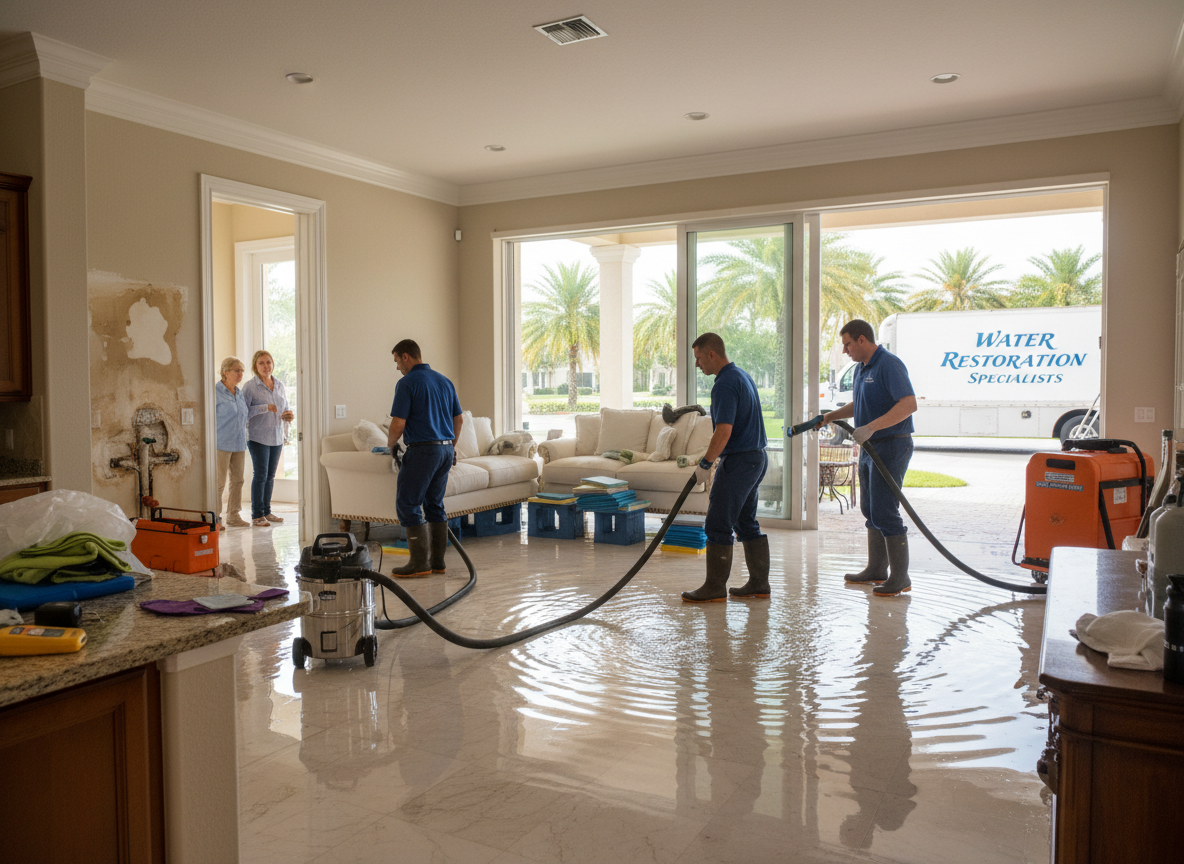
A water leak in a Naples house is usually discovered in the worst possible way: a bare foot on a wet tile, a smell in a guest room, or a brown ring on a ceiling that was white that morning. The first hour is not about drying equipment. It is about stopping the water, keeping people safe and recording what you see before anything is moved. Those three things decide how much of the house has to be opened later.
Stop the water before you do anything else
If water is still running, stop it at the fixture or the shutoff that feeds it. A toilet or a sink has a valve underneath. A washing machine has a valve behind it. A water heater has a cold-water inlet and, on a gas unit, a gas valve. If the fixture valve will not close or you cannot reach it, shut off the main. In a Naples house the main is often at the street, in a utility box near the meter, or at a pressure regulator on the side of the house. In a condo, ask the building manager where the unit shutoff is before you need it.
Do not stand in standing water to reach a valve if the water is near an outlet, a panel or an appliance that is still plugged in. Switch the power off at the breaker first if you can do so without touching water. If the ceiling is bulging, stay out from under it; a ceiling that is holding water can come down without warning.
Keep people out of the wrong rooms
Water and electricity are the immediate danger, and wet ceilings and sagging drywall are the second. Keep children and pets out of the affected rooms, and do not walk across a wet floor more than necessary. If the water is near a panel, an outlet, a light fixture or an appliance, treat the room as unsafe until the power is off.
In a two-storey house, check the ceiling below the bathroom, laundry and water heater. Water from an upstairs leak often shows first in a downstairs ceiling, not in the room where the fixture failed. In a condo, check the unit below if you have a good relationship with the neighbour or the manager; a stain there is the earliest evidence that the leak has travelled.
Photograph and record before you move anything
Take photographs and a short video before you clean up. Photograph the source if it is visible, the water line on the wall or cabinet, the ceiling stain, the floor and anything that is sitting in the water. Open cabinet doors and photograph the cabinet floor. If the water came in at a door or a window, photograph the exterior side too.
Write down the time you found the water, the time you shut it off and what you touched. That timeline is useful to an insurer and to anyone who has to decide whether the damage is sudden or long-term. It also helps the assessment: a leak that started an hour ago and a leak that has been running for a week need different scopes.
What not to do in the first hour
Do not run a household vacuum in standing water. Do not use a shop vacuum unless it is rated for water and plugged into a circuit that is not wet. Do not paint over a damp patch, seal a ceiling stain or spray a household cleaner on a porous surface; those hide the evidence and can make the material harder to assess.
Do not pull up carpet, cut drywall or remove cabinets before the water has been read. A removal that is not documented is hard to explain later, and material that could have been dried may be destroyed for no reason. Do not turn the air conditioning off in a closed house in the middle of summer; a hot, still house is a better environment for growth than a cool one. Do not assume a surface that feels dry is dry. The wall base, the cabinet toe kick and the slab under a floor hold water long after the visible puddle is gone.
Tell us these five things when you call
Call (239) 499-1170 and have five details ready: what is wet, where the water came from, when you first noticed it, whether the water is still running and whether the water is clean, cloudy or contaminated. Add the age of the house and any recent renovation if you know them.
Those details decide what equipment comes out and what material may have to be removed. Clean water from a supply line is a different scope from storm water that came through a door track, and both are different from a toilet or a washing machine discharge. If the water came from a storm, say which direction the wind was from and whether the street or the yard was already flooded.
Rain, tide or a fixture? Naples leaks have different sources
A Naples water leak usually has one of four sources: a plumbing failure inside the house, rain that entered at the envelope, tide or surge that came in at a low opening, or an irrigation line against the wall. The source changes the scope.
A plumbing failure is usually clean water and a smaller wet boundary. Rain that entered at a window track, a lanai junction or a roof edge may have travelled along a cavity before it showed inside. Surge is salt water and is treated as contaminated, so material that took it is usually removed rather than dried in place. Irrigation is easy to miss because it runs on a schedule and the wall can be wet in a dry week. If you are not sure, say so; the assessment is designed to separate them.
The mold clock in a Naples house
Naples air is warm and humid for most of the year, and a damp wall cavity does not need a flood to support growth. It needs moisture, organic material and time. Growth can begin in about a day or two on a damp surface, and a closed house with the air conditioning off can support it faster. That is why the first hour matters even when the water looks minor.
The practical response is not to spray the wall. It is to stop the source, get the material dry and keep the room ventilated while the assembly is being read. If the wall has been wet for days before you noticed, say that on the call. The scope may need containment and removal rather than drying alone.
What the first visit should produce
The first visit is an assessment, not a sales visit. You should see moisture readings at marked points, a description of how far the water travelled and a written scope that separates emergency work from permanent repair. The scope should name what is being removed, what is being dried and which repair belongs to another trade, such as a plumber, a roofer or a general contractor.
If a company cannot tell you where the water came from, how far it travelled and what will be removed, the visit is not finished. A written scope and a set of readings are the minimum. Everything else is a conversation about equipment.
If you are in the middle of it now, call (239) 499-1170 and describe the room. We work from 735 8th St S in Naples and cover the city and eight Collier County communities within about ten miles.