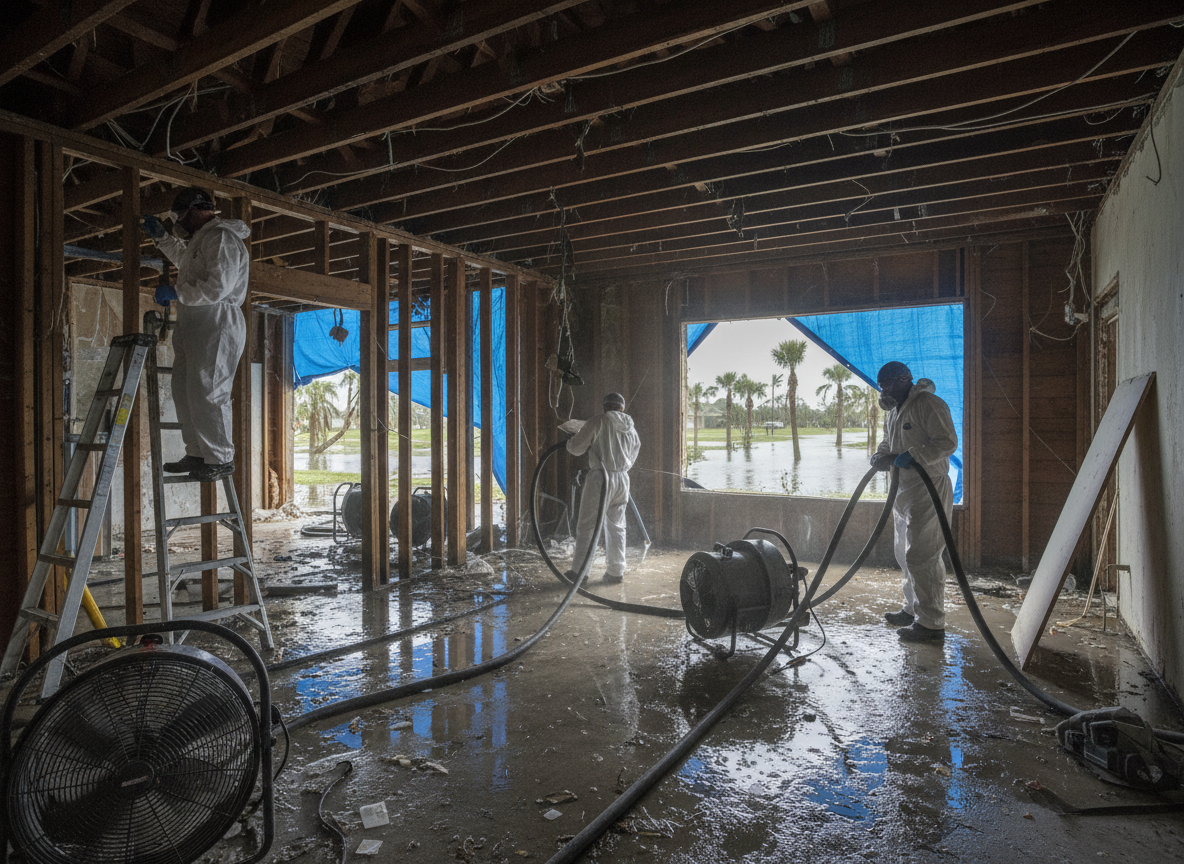
Pelican Marsh is a gated, master-planned community in northwest Collier County, bordered by Naples Park to the west, Pine Ridge to the south and US-41 along its western edge, about eight miles north of downtown Naples. Preserves, lakes and planned construction define the water pattern: a storm that overwhelms a lake outfall, an irrigation line against a wall or a slow supply-line leak behind a cabinet. This page explains what we look for in Pelican Marsh.
What makes water damage in Pelican Marsh different?
Pelican Marsh was planned as a whole, with preserves and lakes built into the layout. That is good for the neighbourhood and complicated for water. Drainage follows a designed path, lot lines sit close to preserved land, and the association controls what can be changed. A leak that starts at a preserve edge may not be fixable by the homeowner alone.
A gated plan built around preserves
Pelican Marsh is a census-designated place of about 2.1 square miles, with 1.94 square miles of land and the rest water. The community was planned with preserved natural areas and lakes rather than filled lot by lot, and US-41 forms its western edge. Preserves are not empty land; they hold water, vegetation and wildlife, and their edges are often the lowest part of a lot. After a wet season, the ground at the preserve edge can stay saturated for weeks, and water moves toward the nearest slab or wall base. Work that alters drainage near a preserve may need association and county approval, which changes the repair sequence.
Lakes and shared edges
Pelican Marsh has lakes that hold storm water and serve irrigation, and many lots share an edge with one. A lake that is full has no capacity to take more, so a heavy storm sends water toward the lowest ground. In a villa or a single-family home on a lake, the wall base on the water side is the first place to read. Irrigation heads that spray a wall add a second source that runs on a schedule, even in a dry week. The combination of lake, irrigation and preserved edge means a damp wall can have more than one cause.
A seasonal, older population
At the 2020 census Pelican Marsh had 2,453 residents, a median age of 71.4 and 2,050 housing units, of which 35.3% were vacant. The community was first listed as a census-designated place for that count, which reflects how recently the area was separated out for statistical purposes, not how recently the houses were built. The practical point is seasonal occupancy: a large share of units are closed for part of the year. A slow weep at a shutoff, a condensate line that clogs or a supply line to the ice maker can run for weeks in an empty unit, and the first sign is often a smell or a stain in the unit below.
Who serves the address
Pelican Marsh is unincorporated Collier County, so building permits and drainage questions go to the county rather than a city. US-41 forms the western edge and is a state road. The community association controls gate access, work hours, vendor approval, roof and common-element repairs, and any change that affects a preserve or a lake edge. For a water job, the first question is whether the failed component is inside the home, in a shared wall or in the drainage system the association maintains.
A Pelican Marsh villa backing onto a preserve
The pattern is easy to picture: a villa on the edge of a preserve, a lanai facing the trees, and a damp wall base after a wet August. The preserve is lower than the lot, the ground stays saturated, and the association is understandably protective of the natural area. Nobody wants the drainage changed, and nobody wants water in the living room. The repair has to work within those rules.
A preserve edge behaves differently from a lake edge. The water is not held in a defined basin with an outfall; it sits in the vegetation and the soil and moves slowly. The shade keeps the ground cooler and damper, and the wall base on that side may never see direct sun. A damp wall can be caused by water moving under the slab from the preserve, by irrigation aimed at the wall or by a roof detail that only leaks in a storm from that direction. Assuming it is the preserve can lead to the wrong repair.
Our sequence is to read the interior wall and the lanai slab, check the exterior grade and the irrigation, and compare the readings with a dry wall on the other side of the unit. If the water is coming from the preserve edge, the correction may be a swale or a French drain on the lot, which needs association approval. If it is irrigation, the head or the schedule is the fix. If it is a roof detail, the roofer owns it. We document the source and the readings so the association conversation is specific rather than a request to "do something about the water".
What does a Pelican Marsh home need?
A Pelican Marsh home usually needs the source separated from the preserve before the interior is opened, because ground water, irrigation and roof water can all reach the same wall. The job starts with a read of the wall base, the lanai and the air-handler closet.
When a storm or a lake has pushed water into a lanai or a ground-floor room, water damage restoration covers extraction and storm damage restoration. In a villa the wet boundary can run along a shared wall, so the readings are taken on both sides and the association is told what the scope covers. Extraction removes the standing water; the storm work reads the opening and the wall assembly.
When an irrigation line, a supply line or a water heater has failed, storm damage repair includes the leak detection that finds the entry. An irrigation or plumbing repair belongs to the trade that owns it, and the detection work tells that trade where to dig or open. The drying that follows is ours.
When a wall, cabinet or ceiling has stayed damp long enough to smell, mold remediation is the next service. In a villa with a shared wall, containment matters because air can move between units. We seal the work area and filter the air before any material is disturbed.
We also cover Pine Ridge, Naples Park, Pelican Bay, Vineyards, Golden Gate and East Naples, all within about nine miles of Pelican Marsh.
Why use us in Pelican Marsh?
Because a preserve-edge home needs the source documented before anyone changes the drainage. We work from 735 8th St S in Naples, about eight miles from Pelican Marsh, and we start with the wall base, the lanai and the exterior grade rather than assuming the preserve is the cause. We separate the water work from the irrigation, plumbing and association repairs, and we put the scope and the readings in writing. We do not publish credentials, ratings or reviews this business has not supplied.
Why Pelican Marsh water damage gets worse quickly
Pelican Marsh combines a designed drainage system, a preserve edge and a seasonal population, and each one can extend the time a wall stays wet. The preserve ground stays saturated after a storm, so a wall base has a continuing source outside it. The shade slows drying. A unit that is closed for the season stays warm and humid inside, so the material does not dry from the air either. Growth can begin in about a day or two on a damp surface.
Hurricane season runs from 1 June to 30 November. Hurricane Ian made landfall in Southwest Florida on 28 September 2022 and was particularly hard on Naples, with much of the damage from a storm surge reported at 10 to 15 feet. Pelican Marsh is inland and about 13 feet above sea level, so surge is not the usual story, but the rain and the saturated ground are. A lake or preserve that is already full has no room for another afternoon storm, and water takes the shortest path to the lowest slab.
How a Pelican Marsh job runs, step by step
- Call and gate access. Tell us the address, the gate procedure and whether the association needs to approve the visit.
- Read the assembly. We mark reading points at the wall base, lanai, cabinet floors and air-handler closet, and scan concealed areas with thermal imaging.
- Separate the sources. We check the preserve edge, irrigation, roof line and plumbing against the interior path.
- Contain and extract. The work area is contained, standing water is extracted and saturated material is assessed.
- Dry against readings. Air movers and dehumidifiers run at the marked points until the assembly reaches a dry standard.
- Verify and hand back. Final readings are compared with day one, and the record names any irrigation, plumbing or association repair.
What's included in a Pelican Marsh job
- A moisture survey of wall bases, lanais, cabinet floors and the air-handler closet
- Thermal imaging where the entry or the path is concealed
- Extraction of standing water and removal of saturated material
- Containment and air filtration where growth is disturbed
- Drying equipment positioned against marked readings
- A written record of readings before and after
- A named hand-off for irrigation, plumbing or association work
Nearby areas we also cover from Pelican Marsh
Pine Ridge is about 1 mile away, Naples Park about 2, Pelican Bay about 2, Vineyards about 4, Golden Gate about 7 and East Naples about 9. All are in Collier County and within the ten-mile service radius from our 8th Street South address.
What should you do next?
Call (239) 499-1170 and tell us whether the home backs onto a preserve or a lake, where the water appeared and when the irrigation last ran. If a wall is damp, keep the area clear and do not paint over it. We cover Pelican Marsh from our base at 735 8th St S in Naples.
Around Pelican Marsh
We regularly work near:
- 📍Pelican Marsh Golf Club
- 📍Pelican Marsh Boulevard
- 📍Pelican Marsh Elementary School
Water Damage Restoration in Pelican Marsh — Local Notes
- •Census-designated place in Collier County, ZIP 34109.
- •Bordered west by Naples Park, south by Pine Ridge, west edge along US-41.
- •Population 2,453 at the 2020 census; first listed as a CDP for that count.
- •About 35% of housing units were vacant at the 2020 census.